Showing posts with label grief. Show all posts
Showing posts with label grief. Show all posts
Sunday, April 10, 2011
A Tribute to Rachel Troxell
I met Rachel Troxell in 1993 when she was still Rachel Levin and we were at Northwestern getting our masters in secondary ed. We took Dr. Boyle's methods class together and I liked her immediately. She was funny and smart and we became friends, the best friend I made that entire year of grad school. We created a kick-ass project on teaching democracy with our mutual friend Sue and Rachel celebrated with me on my 29th birthday and the next year, my 30th, when we were both employed as full-time teachers. Rachel was five years younger, she had entered grad school directly from undergrad, and I felt so old around her, (especially on the heights of the climbing wall she got me to try,) though I never felt anywhere near as wise. You could tell she would be a talented teacher.
The summer of '94, Rachel invited me and Randy to a cookout with her new beau at his place near the University of Chicago. The guy was someone she had met while rock climbing. "He makes video games," said Rachel. "One called Marathon..." This meant nothing to me. Jason Jones seemed a nice enough guy when I met him - I think I made a pie that he liked or I liked his, I forget, but I do remember that Randy was practically trembling when he got the odd chance to meet one of his idols. Rachel and I laughed about it all later, these boys and their games, like we laughed at the younger and sillier boys we taught, both of us in our first roller-coaster years of teaching English at parochial schools - Rachel at Solomon Schechter, me at Gordon Tech. We shared stories of our favorites, Rachel making me laugh so hard at her crush (I so understood) on a sweet sixth grader whom she called "Rhymes with SchmIvan" in the teachers' lounge. Just the way she said it with her irresistibly pretty smile cracked me up.
We took another class together at Northwestern during the summer - it was a course on African oral lit traditions and Rachel's insight and wisdom made it a mind-blowing experience for me. We watched Souleyman Cisse's film Yeelen from the country of Mali - it was about magic and sacrifice and unlike any Western film I had ever seen. I remember so well one moment in class, a moment I have treasured, Rachel and I were examining a cryptic African proverb, teasing out the meaning of its lines, like "My brother walks beside me. He is dark and I am light. He never leaves me..." On and on, it went, rich and obscure poetic imagery that had us stumped. Until we got it. At once. Both of us. "Duality," we said, nearly simultaneously. The passage was about looking at the world and defining it in terms of binary oppositions, rather than multitudes. It was thrilling - not for what we had found at the heart of the knot, but for the moment of discovery. Yeelen means "brightness." A light dawned. Working with Rachel Levin made me feel brilliant and now I am sad because her light has gone.
Reading Rachel's blog of her battle with breast cancer, from her diagnosis at the age of 34 to the end, is both terrible and wonderful. Terrible because the miracle of being reunited with her only happens in my mind as I read. But also wonderful because I can hear her voice again, I am inspired once again by her tremendous courage, strength, optimism and serenity, the depths of which I saw only hints of when we knew each other in our twenties. She had gone on from teaching to do amazing things, including form the LympheDIVAs company which outfits women with wicked stylish options to treat their lymphedema, a frequent side effect of breast cancer treatment. Her loving parents and her business partner continue her work of making women feel good about themselves, a work for which Rachel had a great and special talent.


Friday, October 29, 2010
Mary Scruggs on Humor at OCWW
 The Off-Campus Writers' Workshop hosted comedienne and writer Mary Scruggs yesterday. Mary is currently the head of Writing and Education Programs for The Second City Training Center in Chicago. Her work has been produced in Chicago at Live Bait, the Annoyance Theater and the Circuit Court of Cook County, as well as at the New York Fringe Fest, the LA Women's Theater Festival and LA's Sherry Theater.
Some of Mary's tips:
Separate creation work from revision mode. Improvisers can't second guess themselves. Let the first draft be a mess, a discovery. If it's different than you expected, follow that path.
(At the front of the room, Mary beautifully personified these ideas and the old improvisation adage to "never say no" - every audience suggestion and question was greeted by her with delight. Her glee was absolutely infectious.)
One of the reasons we all get annoyed with our dear old friend Saturday Night Live is that often the skits fade away rather than have a punch line. Mary's take is that the SNL formula has become Premise + Gimmick, and repeat.
Her secret to a satisfyingly comic ending: Figure out what the character wants. This is the "character objective," or the engine that drives the plot. (Works in all narrative, actually, not just the comedic.) A good ending for comedy will be when the character gets what she wants or is definitively thwarted.
What makes for rich comedy is when the character goes about getting what she wants in the worst of ways. (See Steve Carrell's character in The Forty Year Old Virgin looking for love in all the wrong places.)
Our writing job as creators of these characters is Exploring and Heightening the process of their endeavors. Looking for "comic traction," as Mary put it. Exploit it. Traditionally, three times. ("Three guys walk into a bar...") During all this exploring and heightening, Mary urged us to "feel the fear and do it anyway," advice I particularly love.
A comic character has (of course these "rules" are meant to be broken):
- that necessary objective
- a skewed perspective
- flaws ("Heighten them," said Mary. "Hit them hard.")
- a redeeming feature we can relate to. Here is where Empathy is created, where the character's flaws and essential humanity collide.
The set up of a scene, or the exposition, is typically where non-comic or new comic writers spend lots of time, said Mary, to the nods of our description-loving group. (My last short story spent its first 25% just setting the scene. Yeah, I counted.) At Second City, the writer-performers will typically give the audience the least, rather than the most, amount of info that the audience needs to enjoy the scene - Who, What and Where in, at most, three lines. In a two character scene, the first line establishes who one character is, the second line who the other speaker is and what they are doing, the third line raises the stakes. Our spontaneous OCWW example:
"The take-out guy didn't give us potatoes with the order!"
"But that's our last seventy-five cents!"
"What about our hungry kids?"
Not terribly funny, but pretty efficient at setting the scene and conflict, don't you think?
A classic Second City skit has two sisters and their husbands playing a game of Pictionary. "It'll be fun! It'll bring us closer!" say the women. (Can't you already see where this is going to go? Don't you want to see the disaster?) Instead of couple vs. couple, the women and men group up. When one woman draws an X on the board, her sister yells, "Tuna salad!" - the right answer - and the two tell together a story about when they were kids, each chiming in, one hated tuna salad, the other warned her when it was in the fridge with a post-it note, etc. etc. Cute. The men get "Around the World in 80 Days" and bomb, the man drawing taking it all hilariously literally, drawing a big round circle, then starting what you realize, to big laughs, will be eighty hash-marks around it. Cute.
Here's the story point where the scene can go on too long. We've established setting, characters and their objectives, now is the time for a "transformational midpoint" to reframe the scene. The "now it's personal" moment, to borrow from cop movie trailers. In "Pictionary," the men decide they want to actually win. Game on.
"It'll bring us closer." Ha ha.
To end the scene, you need a second turning point, a break of some kind. You don't need to resolve everything - as Mary suggested, "Don't be afraid of leaving a lingering stink in the air." Just break the tension by answering the prevailing question. Using the interminable (to all but Lord of the Rings fanatics) thirty-minute denoument AFTER the famous ring's fate was determined, Mary warned us of the energy slump immediately after climax (giggle, giggle, sorry.) Second City will bring it back up with what they call a "run out" or a "blow" - it's a final punchline before the blackout that gets the comic energy up again, a version of "here we go again!"
Mary's example sounded like one of the character-driven pieces that Second City does really well but whose moderate pace and lack of hard punch would never work on sketch-based TV shows.
(Randy and I saw one of these in Spoiler Alert: Everybody Dies in July where a couple of food tent workers in Grant Park, the man recently from Senegal, the woman from Eastern Europe, take down their restaurant booths and compare notes on the Chicago institution of Taste of Chicago. Charming, lovely, funny. TV-friendly? No way.)
In Mary's example, a woman flips through an invisible rack of clothes when another enters and says, "Honey, I've been looking for you all over the mall!" (Lightening quick exposition.) The mom and teenage daughter spend the scene disagreeing over clothing choices and you come to realize it's one of the last places where they will come together - the daughter moves farther away as the mother criticizes and clings to her declining ability to exact influence over her daughter. Opportunities for funny here, of course, (the daughter's slutty clothes choices, the mom's shock) and also empathy and emotion. The "run-out" line encapsulates all these poignant themes, but also hits a comic high point.
Daughter, as they leave the store: Will you buy me some beer?
Mom: I told you, it was just that one time!
Blackout.
Mary Scruggs generously shared much more, but I'll cut it off with this - "K" words are funny. "Kentucky Fried Chicken" just makes us laugh, for some reason. (For my girls these days, it's all about the "P.")
Saturday, October 9, 2010
Paul: "No Conventional Phrase"

This may be the oddest grief I've ever felt. Years ago I had to necessarily suspend feelings for this person, although his deeply sentimental streak was one of the traits where we had most kinship. We were not good for each other.
His early death was inevitable; I knew this not long after I first met him twenty-two years ago. But I carried a persistent denial - it made the relationship that we had possible - that his body would be as big and unique as his personality and he would beat the devil.
He died in December but I found out only this week. It's been a week of heart-filling beauty - limpid blue skies, trees on fire. A week to be grateful for life. Today I wrote for hours -- Randy took the girls costume hunting -- then biked, hard, down the Green Bay trail, trying to get out of my head. I walked the bike down the sandy slope to the Wilmette beach below Plaza de Lago, then left it to run to the water. After an icy bite, the little waves were cool and good on my legs. Kids in swimsuits, moms in beach chairs. The horizon was hazy; closer in, white sailboats and sailboards dotted the brilliant surface.
I needed to get lost in this beauty. "He's not dead," I told myself this week, because the memories that flooded in were so vivid. I could hear his voice. "I remember it like yesterday," said my friend Dianne. Yeah. But it wasn't yesterday, thank God, and yes, he is gone.
I left my shoes at the water's edge and ran to Gilson beach through the shallows. Waved to our neighbor at his sailboat. Pulled off my sweaty shirt and shorts and walked into the water. July and August had colder water than this. Kept walking, kept breathing through the chill until the water hit my chin and I turned back toward the shore. The cottonwoods have turned pale gold. I sobbed once, twice, three times, - this brilliant life, this lovely, lovely life, an abundance of riches, no more for him. I took a breath, ducked under the surface and emerged. Moved out of the heavy water back to shore.
There were tears enough when we were together. More than enough.
How do you talk about your first lover? How do you forgive him? How do you forgive yourself?
He was a charming scoundrel, a rabbit trickster, a gambler and a con man. He was a sentimental sap and a brilliant writer, an inspired teacher, a comedian, an artist tortured and capable of torture. If what sets us apart from the animals is knowledge of our own deaths, his human burden was unfairly, onerously heavy - he knew all too well the early outcome. He carried the disease not only in his genes, and in his lungs and gut, but on his very skin. Cystic fibrosis obstructs the cells' proper absorption of salt, leaving a salty rime that a mother can taste on her baby's skin, that a lover can taste.
We were together in Iowa, when I was barely earning my master's in film studies and he was a member of the Writer's Workshop. We were together, and then we weren't, then we were again. Then I left him for my friend Greg in the English program, then I cheated on Greg with him and left Greg to return to him.
He bought a dog and we drove with her to his parents' summer house in Manchester-on-the-Sea, north of Boston. He wrote; I waitressed and tried to find production work. After a year, his parents leased the house to a paying tenant and Paul and I had a terrible fight. I left him for two days. He pleaded until, exhausted, I took him back and we moved to a house in Lexington, Massachusetts with his depressed but sexy friend, with whom Paul could not believe I did not cheat. I left him. I got a job in Chicago. He came to Chicago. We were together somewhat; I left to date a man I worked with. And then cheated on the man. With Paul. I left the man I worked with, not for Paul, but because I shouldn't have been with him in the first place.
The eventual end, after four on and off years, spiraled down to dust and nothing amid the debris of quick and angry sex ("I'm a monster," he said the last time, with remorse and guilt, then got up and left), infuriating phone calls that left me pounding the phone with the receiver, revelations of betrayals so far in the past that they almost didn't hurt, and amnesia to all that had been good between us.
If at the beginning of all this lying and cheating and sex, I learned that he had a fatal and incurable disease, and yet continued the lying and cheating and sex, does that make me inhumanly cruel or could it please maybe mean that I looked beyond his disease and dared to grapple with the heart of a real and brilliant and terribly complicated man who happened to be ill and yet refused to be defined by it?
Or.
Could I have been a girl in her stupid twenties who had a huge hole in her heart and in her family and whose neediness was confirmed and partly satisfied by the intensity of his persistent desire and sometime love? Could we have been a match, even if a bad and destructive one, like magnets drawn by the other's weaknesses and absences?
Or.
Could the prescribed steroids he took to remediate his symptoms, and the self-prescribed drinking and tobacco he took to remediate the stuff in his head have exacerbated the rages, the irrational jealousy, the self-destructiveness and the search for temporary oblivion in me and all the other women? Yes, of course.
The last years, the Chicago years, he taught me the Cyrillic alphabet and the ever useful word "Schadenfruede." He introduced me to my beloved Richard Yates and Ivan Turgenev. We laughed at their black and beautiful work, and at the unrelenting sorrows of Young Werther. We recited lines from Dr. Zhivago back and forth in bad British accents: "The walls of his heart were like paper!" "I don't want to believe it if it isn't true!" "They shot the Czar! And all his family!" I called him Pavel when things were good. He wrote my boss a nasty letter about me when things were bad.
The last time we spoke, I had been content, safe, good and happy with Randy for years. I'd gone back to school, jumped with gusto into teaching full-time. He called to tell me he had to put down Lady, the chocolate lab we both loved. I took the phone into the bathroom; the former bank building where Randy and I lived had no reception in the basement and I didn't want to talk in front of Randy. I had nothing to hide from him -- I would share the entire conversation later, but this moment needed to be private. Paul and I wept together as he told me how he held her as she received the injection and as she died. We had loved her; she was funny and good and innocent. We shared this moment of remembering her. I thanked him for calling to tell me and said good-bye.
I have ten thousand regrets, but the only really important one is that I wish I could have been kinder.
He loved to recite the sixth stanza of Yeats's "Under Ben Bulben" - a poem where the poet speaks of himself and his own death in third person. He always recited the words in a rushed, joyous gallop that irked me because I couldn't understand what he said. He laughed at his own drama as he intoned the last lines.
Under bare Ben Bulben's head
In Drumcliff churchyard Yeats is laid.
An ancestor was rector there
Long years ago, a church stands near,
By the road an ancient cross.
No marble, no conventional phrase;
On limestone quarried near the spot
By his command these words are cut:
Cast a cold eye
On life, on death.
Horseman, pass by!
Thursday, September 2, 2010

Wednesday, September 1, 2010
Grief, Redux: Nothing Gold Can Stay

(If you don't already have sympathy fatigue after reading my other grief posts over the hard summer of 2010, feel free to let this story burn up the last of your kind feelings.)
I don't believe coincidences have any more meaning than what we place on them. But I did think of John McGinnis that morning, I did, as I stepped outside the I-94 hotel to get something from the car. I was walking out of the canned lobby air into the morning and its freshness and the sunshine spurred some upbeat musings. Usually when I've thought of my old friend over the years it has been tinged with a bittersweet wonder why I've never met anyone finer. But the night before we had had dinner and swimming with a lovely family and the memory of Mia's happy face and the ease of it all made me think of the possibility.
That morning we had planned to head north to spend the rest of the weekend at Camp Wandawega in Wisconsin. But when I returned to our room from the car, Nora's coughs, little barks we had hardly paid attention to, turned into a bout of throwing up. We decided I would take her home and Randy would go on to camp with Mia.
There was another coincidence that day. Later, a couple of hours before I got the email, Nora and I were resting on our bed, a towel and plastic wastebasket nearby, and I grabbed a book at random from the shelf above the bed. It happened to be I Wasn't Ready To Say Goodbye: Surviving, Coping and Healing After the Death of a Loved One.
And how odd that my last post was partially about him.
I could say the universe was sending me a warning that I was about to get some bad news. Or I could say that the idea of Loss and the memory of this good person who was my friend a long time ago are so often in my thoughts that today was just a day when they happened to come together. Or I could give up on trying to do anything but feel sad that he's gone.
Because John was awesome. A phenomenal guy. Brilliant, kind, gentle, principled, wise, and funny, so funny. Special. His voice was beautifully deep but his laugh boomed even larger and invited you to join in.

He would joke that deep down he was a dull guy with simple tastes, but I found him endlessly fascinating.
We met sophomore year at Notre Dame in a seminar that all arts and letters majors took - a kind of survey of all the disciplines. We read some mind-blowing texts, including The Denial of Death and Invitation to Sociology and Portrait of the Artist as a Young Man and I squirmed silently as the class complained about having to watch Fellini's magnificent 8 ½. They were annoyed it didn't make any sense - I felt like Fellini had tapped into my dreams and put them on celluloid. This was my first year at the school; I was a transfer student from a dinky Baptist college in Libertyville, Missouri we called Billy Jewel Bible School. Here, I felt so intimidated by all the smart kids at the university I could barely speak in class.
One day early in the semester, our professor didn't show up at class time - I later wondered if this was by design to see what the students would do. I sat quietly, like I usually did, too shy to chime in, as people wondered if and when we should leave.
Then John stood up with the assigned book in hand and said, "My parents are both high school teachers. Maybe I'll give this a shot. Let's figure out what was going on in the book we read this week."
I was shocked at his earnestness and his confidence. How brave. But I couldn't admit my admiration. I had to roll my eyes and groan a little as he tried to start a discussion and write salient point on the blackboard.
I must have been groaning a lot, actually, working really hard at showing my contempt for thinking and effort, you know, too cool for school, because John suddenly stopped talking to the class, exasperated, and said, "I'm sorry, Cindy, but I'm trying here!"
My face burned. I was instantly so sorry. And so smitten.
After the discussion stumbled on for a few more minutes and John and the others decided to call it a day, I rushed out of my seat and up to him to apologize. And we became friends.

Friends of a sort - the kind of friend you talk about the David Letterman show with, about how funny Paul Shaffer is and how great Mitch Ryder looked singing "Devil With The Blue Dress" on last night's show. The kind of friend you have a secret crush on but don't tell him because you can't say that. I hung out in the studio when he had his radio show and he let me help him with his set list but I picked some eighteen minute dirge for him to play because I couldn't admit I didn't know as much about Lou Reed's songs as I pretended to.
His favorite poem was Robert Frost's "Nothing Gold Can Stay." I have the poem here in front of me, I'm holding a Xeroxed copy that John made for me. It only took a few minutes to find it in the boxes downstairs, a few strata above the letter with which he took his leave of me. Looking at it burns.
But before the letter there were road trips to see the band X at the Metro in Chicago and to Champaign to watch Nebraska trounce Illinois.
I gave him a ride home from Omaha one Thanksgiving break, not just because I would be visiting my cousin Jeanne, as I said was my reason for being in town, but because I wanted to spend the hours in the car talking with him and sneaking peeks at him when he slept.
(I don't want to write about this. Because I want you to know how incredible he was, how filled with life and this is turning into something about Me and me being uglier than I can even believe now, me being a greedy child at twenty-one, starving, desperate to hold on to any love she can get, lying to myself that it was innocent because it was chaste, panicked into cruel omissions that were really cruel lies and stupid with fear and he was never any of those things because he was fearless. He got up in front of that class and he jumped out of airplanes when he was living in Hong Kong and he was always the same vital and good person, not trying too hard, not afraid of the truth, not needing to try to be anything but the boy who was already a man, filled with integrity and truth.)
I'm going to let the camera fade to black here and let's take it up later because I was shitty to him and he didn't deserve it and he was smart enough to get far away so we weren't speaking when we graduated and I couldn't even let myself think about it because it hurt so much.
He said his favorite poem was "Nothing Gold Can Stay."
Later, later, years later, when I had moved back to Chicago after Iowa and Boston, I ran into some friends of his at The Gingerman and we reconnected and he sent me a letter from Hong Kong where he was interning at the Asian Wall Street Journal.
And I read it and reread it with mixed relief, of course. It felt like I may have been forgiven a little, which I wanted but didn't feel like I deserved. The years since school had taught me what I had done and what it meant. And the letter had a friendly distance that said I had been forgotten some too. And it hurt again to think of what had been broken.
A few years later, the summer of 1997, I was in New York taking a film course. I looked up John's number and called him with a pounding heart.
We met at his Wall Street Journal office in the World Trade Center. At some point in the night he looked at me with something like surprise. Surprise that I still thought of us as friends, perhaps, I don't know, perhaps surprise that the past was still so present for me. He was courteous, cool. Introduced me to the woman he would later marry. We had dinner and talked about a giant table they had brought back from Hong Kong, the city where they met. They walked me to the subway train and we said goodbye.
Perhaps I should believe the Joanna Newsom song I'm listening to right now.
The unending amends you've made
are enough for one life.
Be done.
I believe in innocence, little darlin.
Start again.
I believe in everyone.
I believe, regardless.
I believe in everyone.
When I first got the news that John had died, I sat at my desk, sobbing. Nora came over and rubbed my back with her little five year old hand and said, "Don't think about it, Mommy. It's okay. Let's play Monopoly." So we got down on the floor and we did play. Instead of the top hat and the shoe, she uses her little plastic animals with big heads and oversized eyes for playing pieces. When our two plastic kitties land on Jail at the same time, she'll have them turn to each other and say, "Hello!" "Hello!" "Just visiting!"
We played Monopoly and here was life in front of me and goodness. And every stupid thing I ever did in my life had to be forgiven because this beautiful child and her lovely sister are the wonders that I find at the end of the chain, made with links of iron and gold, thorns and flowers, the chain that I have forged with each day of my life.
John's obit is here.
Sunday, July 25, 2010
Grief, Again
June was hard. You can call grief an understandably human reaction of dismay to the onset of irreversible change, and let me tell you, this summer, my life it is a-changin'.
After losing Phil, on the first day of June, then a few days later absorbing the awful blow of Katy Maguire's death, we got the news that two dear friends planned to separate.
Then another change arrived. It may have been nowhere near as big and painful as that trinity of loss, but the dissolution of the Silicon Valley Moms Group dealt another blow. The SVM Group included over 400 writers across twelve regional sites, including one in Chicago. I wrote forty-nine pieces for the Chicago Moms Blog over the last two and a half years, including two pieces, "Clutter, An Appreciation (See Footnote 1)" and "Bedtime Stories" that were picked up for syndication by the McClatchy-Tribune news service. But the writing support and exposure was only a small part of what makes the loss of this online community painful.
Last weekend I talked with a woman who was one of my mother's friends forty years ago when they were both young mothers of young children. She told me stories about our old neighborhood in LaGrange. "There were fifty-seven kids on Dover Street," Cele said. "You could step out on the stoop and there was always someone to talk to, someone to watch the kids for five minutes while you put something in the oven."
The Silicon Valley Moms Group blogs were a neighborhood of sorts, perhaps without the spontaneous childcare, but with all the divergent voices and personalities you'd find on any residential street. You could witness or take part in communal laughter, encouragement, pain, even the occasional argument, only they took place at the keyboards rather than over the fences. It's the comments that I'll miss, the feedback from readers that would make a post written in isolation transform into a conversation.
Fortunately, three writers and editors from the old group have formed a new collaborative Chicago mom blog where I'll be contributing. You can read many of the former writers from the old Chicago Moms Blog and get your fix for community here at The Chicago Moms. My first post, "Their Marriage," is up and it's lovely to begin the conversations again.
After losing Phil, on the first day of June, then a few days later absorbing the awful blow of Katy Maguire's death, we got the news that two dear friends planned to separate.
Then another change arrived. It may have been nowhere near as big and painful as that trinity of loss, but the dissolution of the Silicon Valley Moms Group dealt another blow. The SVM Group included over 400 writers across twelve regional sites, including one in Chicago. I wrote forty-nine pieces for the Chicago Moms Blog over the last two and a half years, including two pieces, "Clutter, An Appreciation (See Footnote 1)" and "Bedtime Stories" that were picked up for syndication by the McClatchy-Tribune news service. But the writing support and exposure was only a small part of what makes the loss of this online community painful.
Last weekend I talked with a woman who was one of my mother's friends forty years ago when they were both young mothers of young children. She told me stories about our old neighborhood in LaGrange. "There were fifty-seven kids on Dover Street," Cele said. "You could step out on the stoop and there was always someone to talk to, someone to watch the kids for five minutes while you put something in the oven."
The Silicon Valley Moms Group blogs were a neighborhood of sorts, perhaps without the spontaneous childcare, but with all the divergent voices and personalities you'd find on any residential street. You could witness or take part in communal laughter, encouragement, pain, even the occasional argument, only they took place at the keyboards rather than over the fences. It's the comments that I'll miss, the feedback from readers that would make a post written in isolation transform into a conversation.
Fortunately, three writers and editors from the old group have formed a new collaborative Chicago mom blog where I'll be contributing. You can read many of the former writers from the old Chicago Moms Blog and get your fix for community here at The Chicago Moms. My first post, "Their Marriage," is up and it's lovely to begin the conversations again.
Saturday, July 3, 2010
Grief, Part Two

Oh, I can't even write this. I can hardly say it - the words are so wrong. Katy Maguire died. Her heart broke and now the hearts of those who loved her are cracked open. I'm moving through a fog of magical thinking that still insists I will see her again, hear her big laugh and feel her light and warmth, like a beautiful sun here on earth.
A magic more benevolent than my stricken denials followed our friend Katy everywhere. A few summers back, my brother Ron and I ran into her and her beloved daughter Erin on Sheridan Road. We were all riding bikes, Katy and Erin having survived the rock and water balloon missiles from west side kids as they crossed the neighborhoods on their way to the lakefront from Oak Park. Katy laughed as she us told the story of their journey, laughed big as she always did and you had to laugh with her. Meeting her and Erin on the street may have been just another coincidence in a city full of chance meetings, but like everything Katy touched, it had the air of a magical gift.
At one of her memorials, someone described Katy as a modern day pirate who discovered treasure everywhere and shared it with everyone. Perfect, but you also have to picture her as her brother Mike described her, "always coming in the door dressed like a Himalayan Sherpa with a Chihuahua falling out of her purse." I met Katy through work - you can see an example of her film editing here. A short film she made about her son Patrick won awards when Katy was getting her degree at Columbia College; filmmaker D.P. Carlson featured her in his documentary Chicago Filmmakers on the Chicago River.
The memories fly thick as a flock of birds - dancing on the table at one of Katy's raucous parties after the bride-to-be modeled her new lingerie; serene moments in Katy's garden, an Eden of fern grove, goldfish pool, shady arbor for chess games, great swaths of iris, phlox, rose. Katy imitating her daughter Erin's review of the movie Dragonheart: "Dwagons ah ah fwiends!"
And there was a glorious July day with Katy and Erin and my eight-month old Mia on the beach at Lakeside, Michigan. After sunning and swimming in the sparkle water, Katy grilled veggie dogs while Mia and I rinsed off the sand in their clawfoot tub. Was that the day Erin told me her mom was her best friend? I held my sad little baby girl, who couldn't get comfortable and who would cry the entire hellish Skyway ride home in July third fireworks traffic, and I thought I want that kind of relationship with my daughter.
I had made Katy a pie that day, probably blueberry or raspberry peach, brought it up to the little lakehouse under the trees, but my karmic debt to her remains insurmountably high. She gave and gave and gave. Brought our new little family dinner when Mia was four days old. "I love the way babies cry 'la-la-la,'" she told us, holding Mia in her arms. Two years before that, the summer Randy and I got married, when I was too busy constructing hundreds of flipbook invitations to think about my garden, Katie had showed up at my door with armfuls of orphaned marigolds. With the touch of a loving mother, she planted the seedlings, fed and watered them and promised they would grow. They did, exploded actually, into a gorgeous backdrop for our wedding portraits. And she always modeled for me a kind of mothering I wanted to imitate - one that combined fierce protection with tender and gentle love.
 Katy raised Erin and Erin's big brother Patrick with the quiet heroics required of a single mom. Patrick was born with health complications when Katy was twenty-one; Erin is the age now that her mother had her. Patrick now studies environmental sciences and social policy; Erin is studying film, like her mother.
Katy's large and loving family held a memorial for her in Gilson Park on one of the beautiful Saturdays this summer has given us. I rode my bike down to the park, wept at the photos, hugged Patrick and Erin wet from the waves of Lake Michigan, sang the songs, wept more at the heartfelt tributes. At the invitation of Katy's sister, we all raised our hands and called out a thank you to Katy for everything she gave us. It was a beautiful day. When the grief in my chest swelled too heavy to bear, I could look overhead to leaves blowing wild in the wind, look away to the iris blue sky you could see over the harbor and think how much Katy would have reveled in this beauty.
Here is a tribute from one of Katy's yoga friends: http://brookshall.blogspot.com/2010/06/honoring-dead-for-things-we-hold.html
Monday, June 21, 2010
Grief, Part One
 This week was the solstice and in the morning light seeps in, even through the closed blinds and the pulled curtains. I want to keep sleeping, but the light and the birds wake me before seven and once I remember all our simple but complicated plans - Mia's first day of summer "enrichment" with its four part schedule she will need to navigate without her mother, Nora's first day of camp swim lessons which means a return to swim diapers and rubber pants necessitated by the daily dose of Miralax - there will be no returning to darkness and oblivion.
Which is a way of saying that life makes you go on.
My uncle Phil died the first day of June. I had gone to see him in Kansas City two weeks before. For two days I was able to drive Ruth to the nursing home and help her sign the hospice forms and sit with her next to his bed as he slept. For this I will always be grateful. The new room Ruth had requested sat at the end of the hall and Phil had a window that looked on the leaves of an adolescent tree. We sat silently in the dim room, next to his bed, and it felt like a few holy moments of time. I did not want to leave him. I wanted more of him, even if he was only able to answer questions with few words and once, after Ruth complimented his freshly combed hair, make a sweetly funny face that showed a flash of the self-mocking humor we knew as well as we knew the man himself.
He died at the age of eighty-five, long past our expectations, so the news was not a surprise, just painful as a motherfucker.
At the memorial service, however, other surprises fell like a soothing rain - that I was able to plow through the tribute I'd written despite my squealy voice and running nose, that so many dear dear friends and relatives and neighbors came to show their support, including Mike Love from Colorado, that the flowers were so beautiful, that I had no resistance to the minister's traditionally comforting words of future reunions and perfect love, that the chestnut "In the Garden" (Is there a more romantic waltz in the hymnal?) could work wonders on my heart, that my dear old high school friend Tonya would show up and we'd reconcile so easily, that my cousin Jan would delight my girls with gifts of stuffed animals at the post-service lunch, that my brother Ron would decide not to fly back to Denver but instead remain in Kansas City to live closer to family again.
That I could feel these tiny surprises, almost approaching a kind of joy, on such a hard day is, of course, another sign of life breaking through the dulling and numbing binds of grief.
The best moment came back at the house after our girls had a little break at the hotel and the guests had gone. Ron and Randy and Ruth and me and Jeanne and Jan sat in the kitchen and talked and laughed and ate some of the dishes neighbors had kindly brought. The girls had already gobbled their chicken nuggets and asked to go play. The four of us who grew up in this house and the woman who raised us and my husband who helped me make a new family sitting together in one room - it felt like home. Yet as whole as that feeling was, we knew someone was missing from the table and this time he wasn't napping on the couch downstairs or flipping channels in his office. The reminders of his absence were everywhere to seize you up in the chest and gut and bring back some of the dark inside that it will take many mornings to fully let go.
Tuesday, April 7, 2009
Between 22 and 70
When we walked into the party an hour late ("It's in your blood," laughed Uncle Jon), everyone was seated for dinner and the only table left with space for four was in the corner where Twinkles the clown had set up shop.
The clown table turned out to be the perfect place for us at Uncle Sid's 70th birthday party, where we could spread out and not worry about mess nor the girls' preschool version of manners, which included dining on bread, butter, and cake, hiding behind our backs when introduced and begging to leave after Twinkles drove away.
Hiring a clown for the children is just the kind of thoughtful touch my uncle Sid is known for. The fifth kid of seven, he has always been the cutup of the family. He's bigger than life, with a booming laugh that usually dissolves into ticklish giggles, a generous spirit, and an enduring tenderness beneath his teasing. He'd visit when we were kids, reciting his football player "drain bramage" routine with a helmet perched high on his head, cracking us all up, making a wine glass at the Thanksgiving table magically ting without touching it, chasing us kids with his camera. His radio commercials for the jewelry business he named after his sons played on Steve Dahl's show in the 90's and I always loved to hear his rich voice "This is Sid Fey!"
At his 70th party he still tears everyone up and laughs hale and hearty as his back becomes littered with the nametags friends leave with him as they hug.
And hugs were in abundance (Aunt Susan came all the way from Colorado!) as I did the rounds of the room, getting news from cousins (Eric and Kathleen are expecting Sid's third grandchild!) and laughing at old photos of Sid being Sid (jaunty sideburns, plaid sportcoats and magic tricks.)
Uncle Jon asks after my brother and I share the happy news of his daughter, my niece Maggie's 22nd birthday Monday. Our happy wishes for her will need to be long distance all the way to South Africa where Mags is working with AIDS orphans before her graduation with a pre-med degree from Mizzou in May. From Cape Town, she sends tales of culture shock and loveable hordes of children, of safaris and wine tours. Her photos show her after her climb to the top of Table Mountain, stretching her arms over the city and the view of the sea. In another set of pictures, she holds the same pose, opening her arms as she bungee dives from the third highest bridge in the world. Even in still images, the pictures of her flight are breathtaking. She doesn't flinch, holds her body in a perfect posture of Christ, her sacrifice to the air and the sensation.
She is twenty-two, having the spring of a lifetime, six weeks she will never forget. And an entire life before her as well.
A twenty-two year old who can't be stopped, a vibrant seventy-year old. And between them, a life halted too early at fifty two.
Before we left for Sid's party, I received the news of the death of an old friend. Although he taught at the high school where my children will go to school, merely a mile from our house, I first met Greg Harris in New York City. We were taking a summer film seminar at NYU in the summer of 1997. The course, taught by the great Cynthia Lucia, was a primer for high school teachers in media, film and literature courses. John Golden, Mary Christel and Ellen Kruger, who all went on to write books on the teaching of film, were colleagues in the Tisch School of the Arts screening room. Greg was taking the course as prep for creating and proposing a new senior film course at New Trier; the Catholic school where I taught had, ahem, a far less stringent approval process for my little film course.
Spend five minutes with Greg and you got his powerful warmth, his intelligence, his vibrancy. Spectacularly kind. So funny. His part in classroom debates amped the intellectual level; his presence at a table guaranteed a good time.
It was a memorable three weeks. Besides Cindy's brilliant lectures, the engrossing film curriculum and the lively class discussions, we had Manhattan in glorious summer. Greg and I and some classmates hiked up to the Cloisters one Saturday to see the Unicorn Tapestries, Spaulding Grey interviewed strangers in front of an enormous outdoor crowd in Brooklyn's Prospect Park. Brad Pitt was filming Meet Joe Black in the Park Slope Armory; Post headlines screamed the surreal tragedy of Versace's murder. I saw Janet McTeer in A Doll's House and Mary-Louise Parker and David Morse in How I Learned to Drive. I called an old college friend for drinks; we met up at his office in the World Trade Center.
Greg called me about a year later to invite me to create a presentation with him for the upcoming National Council of Teachers of English conference in Denver. We worked together after school for months on "What Makes a Film Art: Designing and Teaching a High School Film Study Course." Yes, Power Point.
Our plan: Greg would speak on researching, designing and defending his new film studies course; I would offer some classroom ideas about "reading sound" to "overcome the supremacy of the image in film studies." Working with Greg was such a pleasure and an intellectual adventure; he was continually supportive, full of great ideas and encouragement. He spoke of his students with respect, generosity and love - his life work, after all, was for them.
By Denver, we had our projected Powerpoint slides, video clips and handouts. A capacity crowd, probably 200 teachers or so. They bellowed with laughter at the kitschy promotional video Randy had cut to entice kids to sign up for my course and laughed again at my comparison of teachers to Toto, pulling away the curtains to show the workings of The Man behind. It was exhilarating. We felt like rock stars.
Greg and I presented at NCTE again in Baltimore in 2001. I would hear news of him through mutual friends, but I think the last time I saw him was in Indianapolis in 2004 where we served together on the organization's Commission on Media. His warmth and humor were high points during the conference when I was beginning to understand that teaching while pregnant and with a toddler at home was not working for me.
This post is sounding more me than Greg, but I have to chalk it up to his incredible personality - Greg had such a talent for making people feel good. His flame was bright and sustaining.
My heart breaks for Jay, Greg's partner of 32 years. I mourn for his students too, but I'm so happy so many of them were able to learn from him.
Here were some of Greg's ideas about the teaching of film from our Denver presentation:
Films provide an outstanding way to meaningfully address diversity and issues of student safety. And films can dramatically help students address our common humanity. In an adaptation from the New Trier English department goals: "From the richness of ideas explored in the study of film, students can recognize and empathize with human experience and gain understanding of the enduring power of the human mind and spirit."
Some of the "rich ideas" that I explore with students include: Questions of justice and truth - by examining the fluidity of truth and the inherent flaws in memory in Reversal of Fortune. The far reaches and consequences of romantic obsession in Vertigo. Confronting our fear and mistrust of what we don't understand and exploring the question - do people come into our lives for a purpose? - through the study of Gods and Monsters.
Bill Condon's Academy Award winning film Gods and Monsters, I believe, will endure as a classic of our time. The film sensitively portrays James Whale, director of the Frankenstein and Bride of Frankenstein films, in the days before his death. It is a film about, among other things, what is monstrous? What is human? It is certainly not a stretch to link Condon's fundamental questions with Gardner's Grendel or Macbeth for that matter. The film can challenge student's stereotypes and force the issue of our common humanity -- issues that transcend sexual orientation, class and education.
The clown table turned out to be the perfect place for us at Uncle Sid's 70th birthday party, where we could spread out and not worry about mess nor the girls' preschool version of manners, which included dining on bread, butter, and cake, hiding behind our backs when introduced and begging to leave after Twinkles drove away.
Hiring a clown for the children is just the kind of thoughtful touch my uncle Sid is known for. The fifth kid of seven, he has always been the cutup of the family. He's bigger than life, with a booming laugh that usually dissolves into ticklish giggles, a generous spirit, and an enduring tenderness beneath his teasing. He'd visit when we were kids, reciting his football player "drain bramage" routine with a helmet perched high on his head, cracking us all up, making a wine glass at the Thanksgiving table magically ting without touching it, chasing us kids with his camera. His radio commercials for the jewelry business he named after his sons played on Steve Dahl's show in the 90's and I always loved to hear his rich voice "This is Sid Fey!"
At his 70th party he still tears everyone up and laughs hale and hearty as his back becomes littered with the nametags friends leave with him as they hug.
And hugs were in abundance (Aunt Susan came all the way from Colorado!) as I did the rounds of the room, getting news from cousins (Eric and Kathleen are expecting Sid's third grandchild!) and laughing at old photos of Sid being Sid (jaunty sideburns, plaid sportcoats and magic tricks.)
Uncle Jon asks after my brother and I share the happy news of his daughter, my niece Maggie's 22nd birthday Monday. Our happy wishes for her will need to be long distance all the way to South Africa where Mags is working with AIDS orphans before her graduation with a pre-med degree from Mizzou in May. From Cape Town, she sends tales of culture shock and loveable hordes of children, of safaris and wine tours. Her photos show her after her climb to the top of Table Mountain, stretching her arms over the city and the view of the sea. In another set of pictures, she holds the same pose, opening her arms as she bungee dives from the third highest bridge in the world. Even in still images, the pictures of her flight are breathtaking. She doesn't flinch, holds her body in a perfect posture of Christ, her sacrifice to the air and the sensation.
She is twenty-two, having the spring of a lifetime, six weeks she will never forget. And an entire life before her as well.
A twenty-two year old who can't be stopped, a vibrant seventy-year old. And between them, a life halted too early at fifty two.
Before we left for Sid's party, I received the news of the death of an old friend. Although he taught at the high school where my children will go to school, merely a mile from our house, I first met Greg Harris in New York City. We were taking a summer film seminar at NYU in the summer of 1997. The course, taught by the great Cynthia Lucia, was a primer for high school teachers in media, film and literature courses. John Golden, Mary Christel and Ellen Kruger, who all went on to write books on the teaching of film, were colleagues in the Tisch School of the Arts screening room. Greg was taking the course as prep for creating and proposing a new senior film course at New Trier; the Catholic school where I taught had, ahem, a far less stringent approval process for my little film course.
Spend five minutes with Greg and you got his powerful warmth, his intelligence, his vibrancy. Spectacularly kind. So funny. His part in classroom debates amped the intellectual level; his presence at a table guaranteed a good time.
It was a memorable three weeks. Besides Cindy's brilliant lectures, the engrossing film curriculum and the lively class discussions, we had Manhattan in glorious summer. Greg and I and some classmates hiked up to the Cloisters one Saturday to see the Unicorn Tapestries, Spaulding Grey interviewed strangers in front of an enormous outdoor crowd in Brooklyn's Prospect Park. Brad Pitt was filming Meet Joe Black in the Park Slope Armory; Post headlines screamed the surreal tragedy of Versace's murder. I saw Janet McTeer in A Doll's House and Mary-Louise Parker and David Morse in How I Learned to Drive. I called an old college friend for drinks; we met up at his office in the World Trade Center.
Greg called me about a year later to invite me to create a presentation with him for the upcoming National Council of Teachers of English conference in Denver. We worked together after school for months on "What Makes a Film Art: Designing and Teaching a High School Film Study Course." Yes, Power Point.
Our plan: Greg would speak on researching, designing and defending his new film studies course; I would offer some classroom ideas about "reading sound" to "overcome the supremacy of the image in film studies." Working with Greg was such a pleasure and an intellectual adventure; he was continually supportive, full of great ideas and encouragement. He spoke of his students with respect, generosity and love - his life work, after all, was for them.
By Denver, we had our projected Powerpoint slides, video clips and handouts. A capacity crowd, probably 200 teachers or so. They bellowed with laughter at the kitschy promotional video Randy had cut to entice kids to sign up for my course and laughed again at my comparison of teachers to Toto, pulling away the curtains to show the workings of The Man behind. It was exhilarating. We felt like rock stars.
Greg and I presented at NCTE again in Baltimore in 2001. I would hear news of him through mutual friends, but I think the last time I saw him was in Indianapolis in 2004 where we served together on the organization's Commission on Media. His warmth and humor were high points during the conference when I was beginning to understand that teaching while pregnant and with a toddler at home was not working for me.
This post is sounding more me than Greg, but I have to chalk it up to his incredible personality - Greg had such a talent for making people feel good. His flame was bright and sustaining.
My heart breaks for Jay, Greg's partner of 32 years. I mourn for his students too, but I'm so happy so many of them were able to learn from him.
Here were some of Greg's ideas about the teaching of film from our Denver presentation:
Films provide an outstanding way to meaningfully address diversity and issues of student safety. And films can dramatically help students address our common humanity. In an adaptation from the New Trier English department goals: "From the richness of ideas explored in the study of film, students can recognize and empathize with human experience and gain understanding of the enduring power of the human mind and spirit."
Some of the "rich ideas" that I explore with students include: Questions of justice and truth - by examining the fluidity of truth and the inherent flaws in memory in Reversal of Fortune. The far reaches and consequences of romantic obsession in Vertigo. Confronting our fear and mistrust of what we don't understand and exploring the question - do people come into our lives for a purpose? - through the study of Gods and Monsters.
Bill Condon's Academy Award winning film Gods and Monsters, I believe, will endure as a classic of our time. The film sensitively portrays James Whale, director of the Frankenstein and Bride of Frankenstein films, in the days before his death. It is a film about, among other things, what is monstrous? What is human? It is certainly not a stretch to link Condon's fundamental questions with Gardner's Grendel or Macbeth for that matter. The film can challenge student's stereotypes and force the issue of our common humanity -- issues that transcend sexual orientation, class and education.
Saturday, March 7, 2009
Grieving Eric
This is the video that Randy cut for Eric Peterson's memorial.
I needed to see this. It's helping me grieve.
Losing our friend has all felt so unreal and out of the blue that news of his death was like a bad joke from Eric's comedy routine, or a sick prank he was pulling.
He was here vital and young one day and gone the next. We'll never know what happened.
Randy pulled out boxes and boxes of high school photos from the basement while he was prepping for the video. Eric looked so funny and shiny and alive, all we could do was laugh. It was so unreal.
But the video made it all come home and I finally sobbed, watching it. Not a bad thing. Just the right thing.
I needed to see this. It's helping me grieve.
Losing our friend has all felt so unreal and out of the blue that news of his death was like a bad joke from Eric's comedy routine, or a sick prank he was pulling.
He was here vital and young one day and gone the next. We'll never know what happened.
Randy pulled out boxes and boxes of high school photos from the basement while he was prepping for the video. Eric looked so funny and shiny and alive, all we could do was laugh. It was so unreal.
But the video made it all come home and I finally sobbed, watching it. Not a bad thing. Just the right thing.
Sunday, March 1, 2009
Eric Peterson 1965-2009
 Randy figures he met Eric when they were about six. Probably at the Lincoln, Nebraska Presbyterian church where Randy's dad was minister and where both he and Eric would be acolytes, wearing long robes, carrying candles and cracking each other up. Here's a picture of them on our wedding day, Eric on the left, Randy with the beer and the ohmygodohmygodohmygod face.
Eric's most recent career, post-stand-up-comedy, had been the Branding and Creative Director for a marking firm in Bangkok and Tokyo. He was in Phnom Penh last week to help preside over the launch of a new mobile service from a Cambodian telecommunications company when he died suddenly.
I didn't know that naming products was an actual career before I met Eric. I always described him as the man who was responsible for Pert Plus and the Savana minivan (get it? sa-VAN-a? Spacious as the African savanna? Clever, eh?) But Eric was so much more.
Gentle with friends, but wickedly funny too. Bigger than life. Big-hearted. As our wedding present, Eric planned a big surprise during the party the night before. He made a wooden rectangular frame on wheels, filled it with wet cement, then passed out dozens of disposable flash cameras to the crowd. Randy and I knelt on red velvet cushions and made our handprints in the cement as the cameras flashed, just like stars at Grauman's Chinese Theater. If you know how much I love old Hollywood (and showing off), you'll get an idea how happy this moment was.


Memorials are being planned in Lincoln and San Francisco.
Later. The San Francisco memorial and celebration will be Saturday, March 7, from 1-4 at the Uptown Bar, 200 Capp Street, one of Eric's favorite hangouts.
A comedy roast will take place at Bangkomedy, Saturday, March 7 at 8:00, Aura Rooftop Bar and Restaurant, 3rd floor, Bangkok. http://aurarestaurant.ning.com/events/bangkomedy-night
You can see Randy's tribute video here.
Condolences for the family can be left at reichmuthfuneralhomes.com
Thursday, April 3, 2008
Thirteen Ways of Looking at a Blackbird
A man has died.
A neighbor, a friend of my husband's, a father to two young girls, died last month. We are shocked, bewildered, sick.
I am trying to wrap my head around this death. I think of Wallace Stevens and his "Thirteen Ways of Looking at a Blackbird." The poet trying to get at the bird, changing the angles of his approach, making volleys at an impenetrable fortress.
A man died. A husband. A father of two girls, a neighbor. Randy worked with him closely a few years ago, considered him a friend, wondered at his recent distance. I waved to him once from the porch and gave his girls Halloween candy as he waited on the sidewalk. I only know him through death. The most bewildering of all choices. The agony he kept secret has exploded into a thousand pieces and is shared by all around him.
After Mary Oliver dodged a Florida alligator, she wrote that suddenly she "saw the world as if for the second time,/the way it really is."
The morning before we heard the news, Randy and I had a loud, brief fight, like a couple of lightning crashes. We yelled through the shower curtain, kept silent truce, shared a few neutral comments in the car, made up over lunch. But a few hours later, with the bad news rolling in my head and knocking in my stomach, our sweet life has a bright light shining on it. If all goes as hoped and I'm incredibly lucky, I’ve only got 40-odd more years with this family – my life is halfway done. And this shining man stands before me, choosing to be with us, choosing every day to stay. For that and the infinite pleasures, blessings and challenges we have yet to face, I am eternally grateful, again.
A man has died. My husband put together a video for the wake, pictures of a golden boy growing into a handsome man, clutched by family, by fraternity buds, by a beautiful girl turned bride, by children. Like the work of an undertaker or a surgeon, my husband is able to put his attention so close to the details of a larger thing that the pressing and difficult reality of the entire can be held at a distance.
"He was brilliant," says my husband. "But he was really funniest when things were at their worst."
A man has died. A poem about Icarus is read at his memorial.
". . . As he neared the ocean,/came close enough to wave to the startled fishermen in their boats,/he laughed,/and admitted/that even had he known/of the many failings of fathers and feathers,/he would have done it anyway."
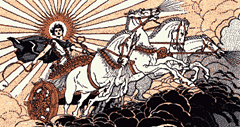
I hear of this and for a moment I confuse Icarus, the boy who flew too close to the sun, with Apollo's son, Phaeton, who flew his father's burning chariot too close to the earth.
A man has died. A poem is read at his memorial. Poetry gives us comfort – we sink into the words, the examination of this tiny moment, here, now. The poet offers understanding, if not of the whole, but of some piece of it.
A man died. The boy-god has scorched us, but we must forgive him because he was a god, because he nearly set the world on fire and because he is gone.
Subscribe to:
Posts (Atom)