Wednesday, April 16, 2008

Possibly the stupidest thing I have done. This week.


"Let’s take the kayaks out!" I said. Becky and I were sitting in the sun on the shore of Fox Lake last Sunday afternoon. Becky is my cousin. She is one year older than me, we played together a hundred years ago, now she's got three huge sons, (the youngest in high school!) and whenever I get the chance to see her, I feel like a kid again.

I ran inside to grab a hat and my jacket and get Becky an extra sweater. "The lifejackets are in the laundry room," said Randy but I couldn't find them. "We'll stick to the shore," I said or some nonsense like that. Becky left her shoes.

"Turn your paddle around!" called Becky's husband Rich as we launched. Rich had brought the 8-foot kayaks for fish he never caught that day. I flipped around the blade of my paddle so it would do some work scooping the water instead of just mixing the lake.

We pushed off from shore and I spun around in a couple of tight circles just because I could. "Whee!" Randy would watch the girls. He didn't say a word because we had company. I felt like I was running away - for a harmless hour or so.

The kayaks moved smooth and swift over the glassy water. It was so much fun to tool along the lake’s shoreline, peeking in the windows of the houses, laughing at the little white dog we could see but not hear yapping furiously at us from behind a sliding glass door. We waved to fishermen, made note of a lakeshore bar with an outdoor deck, passed a mysterious pile of snow. I caught a glimpse of the tail end of a splash as a fish sunk back in the water. Seconds later Becky and I squealed at the sight of the entire ugly beast flipping up in the air.

Becky told me stories about getting stuck with a flat tire at Midway and walking down Cicero Ave in the dark and almost getting into a fight with a woman on an airplane and I got to say “Oh No She Didn’t!” She told me about a friend of her oldest son, a young girl who died of a rare kind of brain cancer and I cried out loud because the girl told Brad, "I'm so sorry, I don't want to go on your birthday." She died two days later and as Becky was finishing that story, we had reached the far side of the lake. I was wiped out. The sun had changed its angle, we thought we'd been out for hours. The idea of following the shoreline all the way back around again felt really hard; I just wanted to get home. I could just make out the smeary dot of our house on the other side. We didn't even make a decision. We just set out straight across the lake for home.

Now I’ve done some doozies in my life, haven't you? College idiocy comes to mind. Some colossal misjudgments of character at work. Bad choices in romance.

But as cringe-producing are the memories of these missteps, they all fade into nothing more than silliness now that I've got children counting on me.

We have no snacks. I check my pockets and find a tampon and two dollars.

The highest waves on the rumpled surface of the water are no more than six inches and the sky is as soft as a John Constable oil painting, but my mind, as it does when my blood sugar starts descending, scurried from the Armageddon dream I had last night to the Chicago magazine story I'd read of two men nearly perishing in their kayak crossing of Lake Michigan.

The air is cool and comfortable. I've opened my jacket. Water occasionally drips on my legs from the paddle, but it's not unpleasantly cold. But I look at the water and realize that if we fall in, hypothermia would set in within moments. I think of the enormous pile of ice we saw sitting mysteriously on the shoreline. It dripped and glistened.

I start turning my paddle straight vertical as I stroke, pushing my back and arms into the effort.

Straight ahead I see a pink and brown dot on the steps, topped with a bright head. It's little Nora. Perhaps she sees us.

When I tell this story later to a friend, he laughs and says, "If you capsized, you could have walked home."

Sunday, April 13, 2008

Drowsy Chaperone Update


Did I laugh? Until I nearly choked. Did I cry? What do you think? Not that there were many tender moments here - the sweetest love ballad had lyrics like: "I put a monkey on a pedestal and then he ran away... He left his jacket on the pedestal and his little rusty cup... Oh monkey, monkey, monkey, you broke my heart in two..." (This was one of my choking episodes.)

But I found myself tearing up during a little number ten minutes into the show called "Cold Feets" - a song that was little more than an excuse for some great tap dancing - classic, perfectly executed, with blithe and dazzling smiles by Mark Ledbetter and Richard Vida. This show's book drips with irony, but the triple joke is that all of the stagecraft is rendered with spectacular honesty. I'm transported back to Band Wagon and "I Guess I'll Have to Change My Plan."

But the sincerity of the singing and dancing wasn't enough to have me weeping - it was how the show gets to the heart of the meaning of escapism. Much of the show's humor and poignancy arises from its post-modern situation - a 1920's era Broadway show is taking place in the drab apartment and imagination of The Man in the Chair - a lonely Broadway connoisseur who puts on his old records when he's feeling blue. Much like Woody Allen's Purple Rose of Cairo and the 1981 Pennies from Heaven with Steve Martin and Bernadette Peters, but without their grimness, The Drowsy Chaperone never lets you forget the harsh reality that the airiest musical confections temporarily erase.

Friday, April 11, 2008

Thursday, April 3, 2008

Thirteen Ways of Looking at a Blackbird


A man has died.

A neighbor, a friend of my husband's, a father to two young girls, died last month. We are shocked, bewildered, sick.

I am trying to wrap my head around this death. I think of Wallace Stevens and his "Thirteen Ways of Looking at a Blackbird." The poet trying to get at the bird, changing the angles of his approach, making volleys at an impenetrable fortress.

A man died. A husband. A father of two girls, a neighbor. Randy worked with him closely a few years ago, considered him a friend, wondered at his recent distance. I waved to him once from the porch and gave his girls Halloween candy as he waited on the sidewalk. I only know him through death. The most bewildering of all choices. The agony he kept secret has exploded into a thousand pieces and is shared by all around him.

After Mary Oliver dodged a Florida alligator, she wrote that suddenly she "saw the world as if for the second time,/the way it really is."

The morning before we heard the news, Randy and I had a loud, brief fight, like a couple of lightning crashes. We yelled through the shower curtain, kept silent truce, shared a few neutral comments in the car, made up over lunch. But a few hours later, with the bad news rolling in my head and knocking in my stomach, our sweet life has a bright light shining on it. If all goes as hoped and I'm incredibly lucky, I’ve only got 40-odd more years with this family – my life is halfway done. And this shining man stands before me, choosing to be with us, choosing every day to stay. For that and the infinite pleasures, blessings and challenges we have yet to face, I am eternally grateful, again.

A man has died. My husband put together a video for the wake, pictures of a golden boy growing into a handsome man, clutched by family, by fraternity buds, by a beautiful girl turned bride, by children. Like the work of an undertaker or a surgeon, my husband is able to put his attention so close to the details of a larger thing that the pressing and difficult reality of the entire can be held at a distance.

"He was brilliant," says my husband. "But he was really funniest when things were at their worst."

A man has died. A poem about Icarus is read at his memorial.

". . . As he neared the ocean,/came close enough to wave to the startled fishermen in their boats,/he laughed,/and admitted/that even had he known/of the many failings of fathers and feathers,/he would have done it anyway."

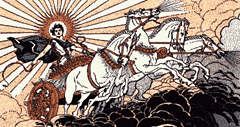
I hear of this and for a moment I confuse Icarus, the boy who flew too close to the sun, with Apollo's son, Phaeton, who flew his father's burning chariot too close to the earth.

A man has died. A poem is read at his memorial. Poetry gives us comfort – we sink into the words, the examination of this tiny moment, here, now. The poet offers understanding, if not of the whole, but of some piece of it.

A man died. The boy-god has scorched us, but we must forgive him because he was a god, because he nearly set the world on fire and because he is gone.