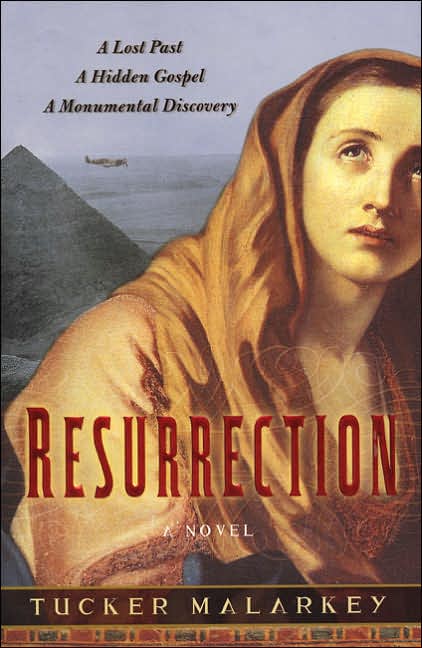
An Interview with Tucker Malarkey, author of Resurrection. Penguin, 2006.
Tucker Malarkey’s second novel, Resurrection, uses the true story of the 1945 discovery in Egypt of ancient Gnostic texts containing alternate accounts of Jesus’ life and words as a backdrop to the compelling story of one woman’s journey from spiritual fatigue and emotional aridity to renewal, understanding and love.
Gemma Bastian, a nurse during the London Blitz, hears of her archeologist father’s death shortly after he has sent her word of making “an unexpected find, a find her rebellious spirit will appreciate.” As she searches for clues about her father’s mysterious death, she discovers tantalizing fragments of the Gnostic Gospels while becoming involved with two half-brothers: Michael, a veteran fighter pilot, haunted by his war experiences, and Anthony, an illusive scholar familiar with her father’s work. Her stormy relationship with the two men mirrors the dramatic changes she undergoes by reading the newly uncovered gospels.
Beautifully written, with lyrical passages reminiscent of Michael Ondaatje, Malarkey’s thrilling story reaches an extraordinary climax as Gemma and Anthony translate and read passages from the newly found gospels. Readers unfamiliar with the Gnostic Gospels will share a sense of wonder at their discovery with its quietly earthshaking message: humanity has suffered much by losing these words of Jesus.
Q: Please talk about finding the book you’ve called the inspiration for Resurrection, Elaine Pagels’ National Book Award winning The Gnostic Gospels.
Malarkey: Elaine Pagels writes a wonderful account of the discovery of the Nag Hammadi texts in this book. Resurrection is loosely based on the events she describes. These ancient gospels, written in Coptic on papyrus pages, were discovered in 1945 by a Bedouin peasant digging for soil in Upper Egypt. The books, found in an earthenware jar near the ruins of the St. Pachomius monastery, proved to be part of a collection of sixty or so gospels that were widely circulated and read in the 4th century—ancient best sellers, if you will.
In that same century, when the new church outlawed all gospels save for the four selected for the New Testament, it seems probable that some of these holy men from the monastery buried these texts, perhaps with a prayer that someday they would be dug up, that their wisdom would not be lost.
When I started doing research on them, I asked friends, peers, elders, people with education and learning if they knew anything about these texts. Had they even heard of Nag Hammadi? There was a resounding silence. The fact is, the gospels did not become available to the public until the 1970’s.
When I started to investigate the content of these (in some cases only recently translated) gospels, my blood began to boil. What began to emerge was a picture of a Christianity that I never knew existed -- one of wisdom and beauty and openness. As I learned more, I started to feel something like betrayal. I didn’t know if it was a rational response, this sense that something precious had been stolen—a belief system more varied, generous, and mystical than the one Christians have today. It was as if the story of Christianity had once been a great and complex work of art, full of characters and color—a masterpiece. What history brought forward was a faded sketch, the merest outline in black and white. I guess it felt like a deprivation. The flip side was the incredible gift of this material resurfacing, of the masterpiece coming back to life.
Q: You have said: “The church is a political and fairly bloody institution . . . When faith and politics are married, anything can happen . . . The Gnostics were very democratic, (they) never got themselves organized to do anything.”
What do you think of the possibility that creating a worldwide church, across cultures, across ages, may be impossible in a democratic fashion? Does religious organization require oversimplification and quelling of disparate and contradictory voices?
Marlarkey: I think most modern organizations religious or otherwise operate on that premise. A hierarchical power structure is straight forward, and a model we’re familiar with – from the days of the early church. Those at the top have the knowledge and the power – they have the voice. I think, however, that harmful assumptions can be made by leaders about the people they are ‘leading.’ They sometimes assume a level of ignorance, when really people are as strong, resourceful and informed as they feel they need to be. In a system where they have no real say, what’s the point in fighting ignorance? If someone else is going to decide for you, why bother getting an education? The war in Iraq has done a lot to wake Americans up to how their country works -- and doesn’t work. It’s been a shock to a lot of us.

Q: What do you see as the place of faith in an open-minded searcher’s life? Must faith always be opposed to reason?
Malarkey: My grandmother was an Episcopal nun. She had two lives; the first as a wife and mother of four, the second as a silent contemplative. I never knew her in her first life; I never saw her out of her long, black habit. She was deeply interested in the events of the secular world. She read everything: Not just The New York Times and USA Today, but Reader’s Digest, The New Yorker, Harper’s and The Atlantic.
In her silent community on the Upper West Side of Manhattan we would sit in the little “talking room” and I would listen to her quietly hold forth on both the life of the mind and the life of the soul. I remember asking her if she really believed in God. She smiled and said, yes, but not in some gray-beard up in the clouds. She told me she came to religion when she understood that God lives not in the clouds, but in the hearts of people.
She added that she wished she was more like some of the novices in her order, and that faith came easily. She had to fight every day for it. The intellect, she said, was a great stumbling block. But it was dangerous to exclude it. You had to bring all parts of yourself to your faith. You had to come to it on your own terms; it was dangerous to divide yourself. It was with my grandmother that I first learned you could cross safely from the land of the learning to the land of faith, that the two were not, as it sometimes seems, at war.
I have this idea that in their highest forms, these polarities meet and become one. They are starting to find evidence of this in science, that, essentially consciousness is God, and the reverse. It’s a very hot debate in this country, and both communities are threatened by the claims of the other. On the faith side, it’s reported that 40% of Americans believe that the dinosaurs died in Noah’s flood – that the earth is only 10,000 years old. And on the scientific end, an equally strong counter-threat – that there is thought to be a ‘God gene,’ that predisposes one to faith -- that God can be explained by science. You can see why there is some contention. At the moment there seems to be no middle ground. I think it’s essential to create a place where the two sides can meet peaceably. I suppose Resurrection was my attempt at offering something towards creating that place, and adding to the dialogue.
Q: Would you mind talking about your own spiritual journey? Did you find yourself working through your own questions as you researched and wrote Resurrection?
Malarkey: Like my grandmother, I believe there is something more out there: a divine plan and order, though personally I cannot assign this belief to one religion. I have kept my mind (and soul) open and found answers – and great similarities – in everything from meditation to the great religions of Judaism, Islam and Buddhism – not to mention Christianity.
The issue of faith is present in most everything I've written. Resurrection shares themes of my first published book, An Obvious Enchantment. I guess you could call it "religious anthropology", though Enchantment centered on Islam and the Koran. Resurrection centers on the discovery of the Nag Hammadi Gospels in Egypt, 1945.
This astonishing archeological find opened a window to a branch of Christianity most don't know existed. These Gnostic Christians were considered a threat to the forming Catholic Church, partly because they believed that the way to God was through gnosis, or self-knowledge, and that there was no need for an intermediary or church. In the fourth century, the Gnostics were labeled "heretics" and their texts were outlawed and ordered destroyed by the Church Fathers. It seems, however, that these "heretical" texts were well known and loved. Someone found a way to preserve them. The story that unfolds in Resurrection involves some of the real life events that took place around the appearance of these texts in Cairo in the 1940's. While wrapped in a larger tale of love, war and murder, Resurrection is primarily a story about faith. It is a story about a Christianity we never knew, and a faith that was buried – a faith that instructs one not to ignore learning, and to seek God within. I am moved beyond words by what I learned researching this book, and sharing this knowledge – this lost faith – with others has become a primary motivation for writing it.
Q: When they meet, Michael, the bitter war veteran and Gemma, the shell-shocked nurse, look at each other in “a silence that would not have existed before the war.” (page 14) Michael later describes his war experiences in this way: “They take away your senses along with your fear. They don’t tell you that while your body may survive, your heart turns to granite.” (page 203)
Your description of characters suffering the fatigue of war and apprehensions of a new Israeli-Arab war feels very contemporary. Were you inspired by the experiences of American soldiers in Iraq?
Certainly they were on my mind. Like half of America, I was vehemently opposed to the war in Iraq. I marched in rallies and found myself becoming politicized by the process. War will do that. I think that anyone who starts a war for no good reason has never been in one, and certainly has no idea of the cost. I read that 70% of the homeless in this country are war veterans. They are so displaced, so traumatized, so damaged by their service to the commander in chief – and they fall through the cracks when they get home. It’s an unimaginable and often unnoticed sacrifice. Michael certainly feels some of this dislocation. He has lost the life he had before the war. It is a hard, if not impossible, loss to recover from.
Q: You paint an amazingly powerful vision of what revolution in the church could accomplish: women with equal power in the church, all religions accepted and respected, ignorance considered sinful. How hopeful are you of this vision coming to fruition?
Malarkey: Within the confines of the current Roman Catholic Church? Not very. But America is an astonishing country, capable of so many things. People want community and commonality; they want to believe in something. There are many alternate Christianities out there and they are growing stronger. There are even some Gnostic churches. Anything could happen, really, when the time becomes right; when people need a change. Look at what happened in the last elections!
Tucker Malarkey will be at Women and Children First in Chicago on April 11 and at Harry Swartz Bookshop Brookfield in Milwaukee on April 12.


